Initially, Nazi leaders were skeptical or outright opposed, seeing the Olympic Games as a vehicle for “individualistic-democratic” ideals that conflicted with their nationalist, exclusionary vision. This initial skepticism shifted dramatically after Hitler came to power in 1933, when he and his propaganda minister, Joseph Goebbels, recognized the Olympics’ potential to broadcast Nazi ideals globally. The Games soon became a central tool for Nazi propaganda, designed to present a powerful and unified image of the Third Reich to the world.
The Olympic Games: A Plot Against the Aryan Race by Freemasons and Jews
Before 1933, the Nazi Party’s views on the Olympic Games were marked by suspicion and disdain, stemming from their rejection of internationalism and racial diversity. Publications like the NS-Monatshefte, a Nazi ideological journal, criticized the Olympics as an expression of “individualistic-democratic” values that clashed with the Nazi vision of a racially homogenous society. The Nazis favored Turnen, a form of German gymnastics emphasizing synchronized movements and physical discipline, which they considered more aligned with national pride and unity than the competitive, international nature of the Olympics.
Their opposition became especially pointed following the 1932 Olympics in Los Angeles, where African American athletes like Eddie Tolan excelled.
The Völkischer Beobachter, the primary Nazi newspaper, scorned the participation of Black athletes, labeling it a “degradation of the Olympic idea” and demanding their exclusion from the upcoming Games in Berlin. Hitler himself called the modern Olympics “A Plot Against the Aryan Race by Freemasons and Jews,” illustrating the extent of the Nazis’ early opposition before they eventually saw the Games as a tool to promote their ideology.
The Change After 1933
With Hitler’s rise to power, the prospects for hosting the Olympics in Berlin changed dramatically. The IOC and Germany’s Olympic Organizing Committee, founded on January 24, 1933, were initially alarmed due to the Nazi Party’s openly negative stance on the Games, viewing them as contrary to their nationalist and racial ideologies. There was considerable uncertainty about whether the Nazis would even permit Berlin to host.
On March 16, 1933, Theodor Lewald met with Adolf Hitler to discuss the 1936 Olympic Games. Although initially indifferent to the event, Hitler surprised those present by offering his support. His decision may have been driven by several practical considerations. The Games presented an opportunity to improve Germany’s international standing and counteract growing negative perceptions abroad. Hitler also recognized their economic potential, seeing them as a way to attract foreign currency and stimulate domestic activity. Furthermore, with millions of Germans unemployed, large-scale construction projects like the Olympic venues aligned with Nazi employment policies. Finally, the Games fit within broader plans to transform Berlin into a monumental city, showcasing the strength, unity, and modernity of the “New Germany” under Nazi rule.
Bitter detail: after the April 1 boycott against Jewish businesses, the according to Nazi-theory “Half-Jew” Theodor Lewald faced backlash and eventually had to resign from most of his roles due to anti-Semitic pressure, though he remained head of the Olympic Committee to avoid losing the Games.
The German Organizing Committee informed the IOC: “We will expend all our efforts to make the upcoming festival as dignified as previous modern Olympic Games and to embody the noble Olympic ideals within it.” They further emphasized that the German nation stood united in support of hosting the XI Olympic Games in Berlin, stating, “All of Germany is excited to welcome the peoples of the world at the upcoming Olympic Games.”
Hitler: “The Grandest Stadium the World Has Ever Seen”
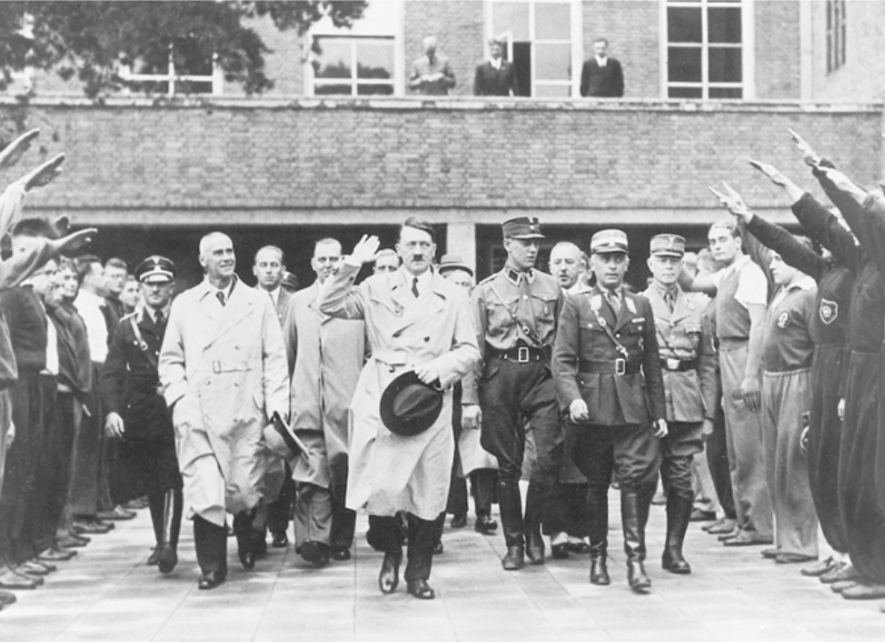
On October 5, 1933, Chancellor Adolf Hitler visited the Reich Sports Field, where the Olympic site, including the expansion of the Grunewald Stadium and the Sports Forum, was planned. To the surprise of many Hitler insisted there that the expansion of the stadium would be too little for Germany’s Olympic ambitions, and anounced the construction of a completely new stadium complex, stating, “With four million unemployed, you need to create work.” Until then, Hitler had displayed little interest in the Games in public. But this time he stated: “This should not be a humble, self-financing event, but a monumental spectacle in the grandest stadium the world has ever seen.” He added, “…when the whole world is invited, it must be something magnificent… a few million doesn’t matter.”
Sources
- Hitler’s Games: Race Relations in the 1936 Olympics – David Clay Large
- Die Olympischen Spiele Berlin 1936 -eine Bilanz nach 60 Jahren
- Olympische Sommerspiele Berlin 1936 – Festspiele der Propaganda?
- Olympische Sommerspiele 1936 – Wikipedia
- Theodor Lewald – Wikipedia
- Die Olympischen Sommerspiele 1936 in Berlin im Zeichen der Propaganda?
- Sport und Sportmedizin im nationalsozialistischen Deutschland – Jörn-Arne Ristau
- Da kann man nur noch Nazi werden – Spiegel Sport – Heinz Höhne
- The Will of the Führer? Financing Construction for the 1936 Olympics – Darren M. O’Byrne and Christopher Young